The Difference Between Learning Online Business and Earning Online
Your course library is impressive. Seriously. You've got the Facebook ads masterclass, the email marketing bootcamp, the SEO secrets program, the Instagram growth blueprint, the funnel building intensive, and at least six different "passive income" courses sitting in your digital vault. You've consumed hundreds of hours of training content, taken meticulous notes, and bookmarked countless resources.
Your knowledge? Expert level. Your bank account? Suspiciously unchanged.
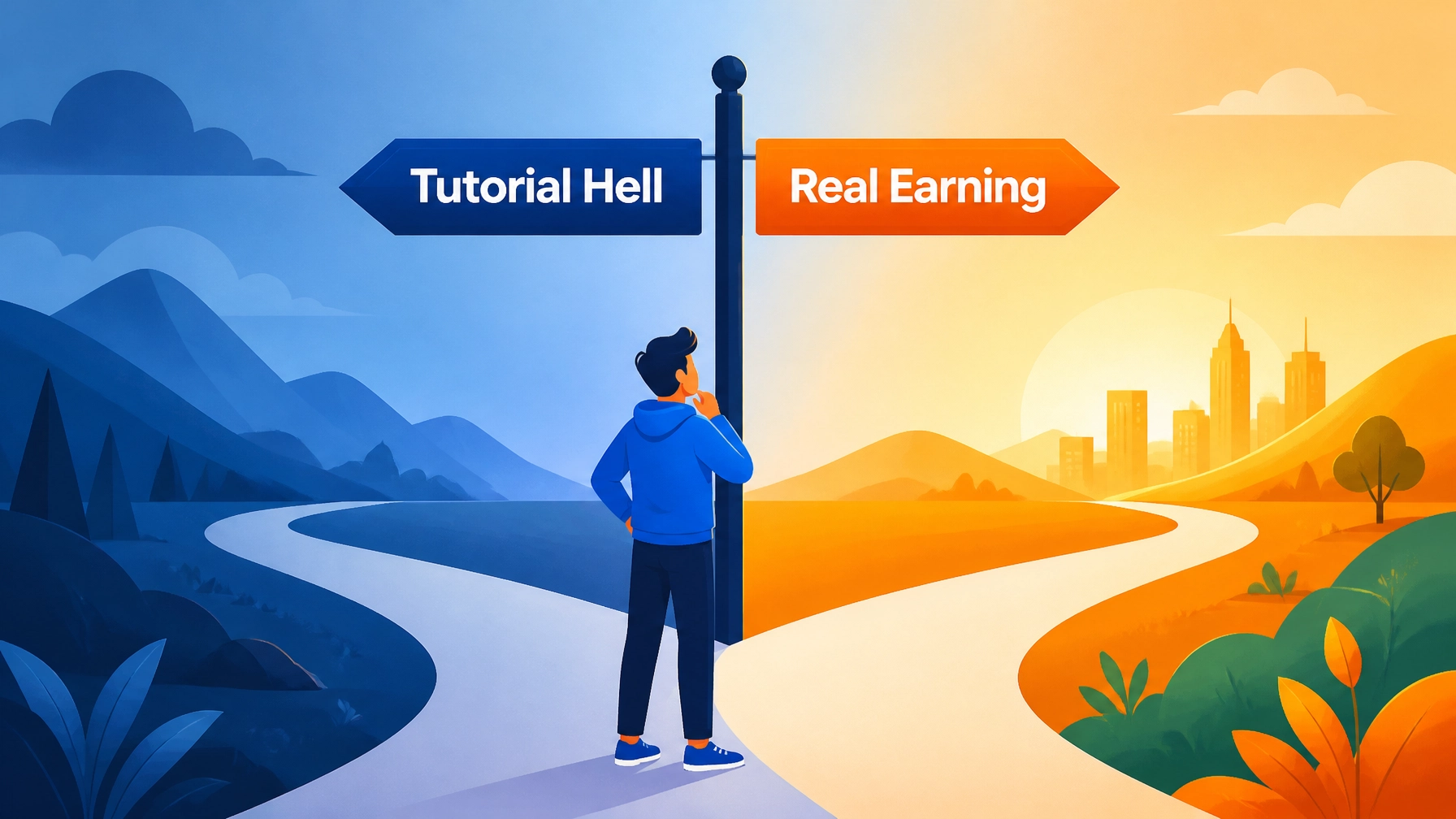
This is the paradox destroying aspiring entrepreneurs every single day: you can become an expert in online business without ever making a dollar online. The gap between learning and earning isn't just wide—for most people, it's a chasm they never successfully cross.
Let me show you why this happens and, more importantly, how to finally bridge that gap.
The Learning Addiction: Why Education Feels Like Progress
Here's an uncomfortable truth: learning is easier than earning. Consuming a course feels productive. Watching tutorials gives you a dopamine hit. Taking notes creates the illusion of forward movement. Your brain registers all this activity as progress because you're genuinely acquiring information.
But information without implementation is just entertainment. And expensive entertainment at that.
The online business education industry has perfected the art of keeping you in perpetual learning mode. They've discovered that people asking "what type of online business is most profitable" or "is an online training business profitable" are infinitely more valuable as repeat customers than as successful competitors. So they design their products to feel comprehensive while subtly encouraging you to buy the next course, the advanced training, the updated version.
The Professional Student Trap: When learning becomes your primary activity instead of your support system for doing, you've become a professional student. Professional students can speak fluently about strategies they've never implemented, quote gurus they've never emulated, and explain concepts they've never applied. They're knowledgeable and broke—a tragic combination.
Why Your Brain Prefers Learning Over Earning
Your brain is wired to avoid risk and uncertainty. Learning is safe—there's no rejection, no failure, no public exposure of your inadequacy. When you watch a course, you can't fail. When you take notes, you can't be criticized. When you're "preparing," you don't have to face the vulnerability of putting your work into the world.
Earning, on the other hand, requires risk. You have to create something that might be criticized. You have to reach out to potential customers who might reject you. You have to price your offer and face people who think it's not worth it. You have to be visible in ways that feel uncomfortable.
So your brain offers a beautiful compromise: "Let's just learn a little more first. Once we're fully prepared, then we'll start." Except "fully prepared" never arrives because there's always another skill to learn, another strategy to master, another course that promises to fill the gaps.
The Earning Mindset: What Actually Generates Revenue
Let's establish something fundamental: earning requires different actions than learning. This sounds obvious, but most people miss it entirely. They think that sufficient learning automatically translates to earning. It doesn't.
Learning Activities vs. Earning Activities
Here's the distinction that changes everything:
Earning Activities (Generate Revenue):
- Creating offers and putting them in front of potential buyers
- Having sales conversations with real prospects
- Publishing content that attracts your target audience
- Building an email list and sending promotional emails
- Running ads to drive traffic to your offers
- Following up with leads and closing sales
- Delivering your product/service and getting testimonials
Learning Activities (Consume Resources):
- Watching course videos about how to create offers
- Reading books about sales techniques
- Studying other people's content strategies
- Learning email marketing best practices
- Researching advertising platforms and strategies
- Taking notes on closing techniques
- Analyzing successful case studies
Notice the pattern? Learning activities are passive and safe. Earning activities are active and vulnerable. One prepares you theoretically; the other exposes you practically. One costs you money; the other has the potential to make you money.
The most successful entrepreneurs spend roughly 80% of their time on earning activities and 20% on learning activities. Most struggling entrepreneurs have this ratio reversed—or worse.
The Implementation Gap: Where Knowledge Goes to Die
You've probably experienced this: you finish a course, you're fired up, you understand the concepts clearly, and you tell yourself "I'm definitely going to implement this!" Then... nothing happens. A week passes. A month passes. The course gets buried under newer courses. The implementation never occurs.
This isn't a discipline problem—it's a system problem. Implementation requires:
- Immediate action: Implementing within 48 hours of learning, not "when you're ready"
- Simplified steps: Breaking the strategy into actionable micro-tasks
- Accountability: External pressure to follow through
- Feedback loops: Quick results (positive or negative) that validate effort
- Course correction: Adjusting based on real-world data, not theoretical perfection
Most courses teach you what to do but provide zero structure for actually doing it. They dump information and leave implementation entirely up to you—which is why implementation rarely happens.
The Profitable Business Models: Beyond Theory
People constantly ask "what type of online business is most profitable" as if there's a magic model that guarantees success. The uncomfortable answer? All of them and none of them. Profitability isn't determined by the business model—it's determined by execution quality.
The Real Profitability Factors
Whether you're selling physical products, digital courses, services, or affiliate offers, profitability comes down to:
1. Solving a Specific Problem: Vague solutions to vague problems generate vague interest. "I help people improve their life" makes no money. "I help software engineers negotiate $30K+ salary increases" makes money because it's specific and measurable.
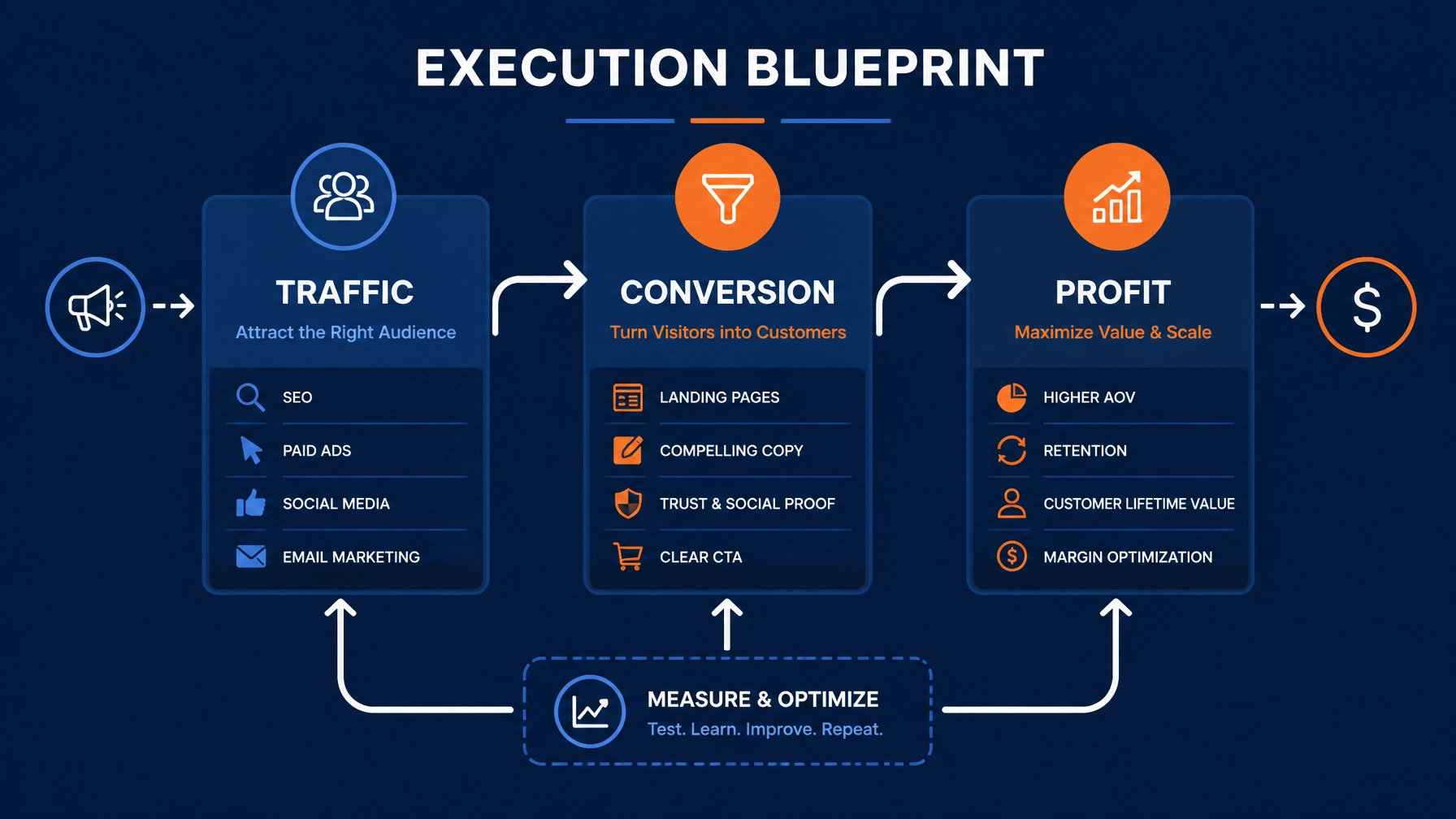
2. Reaching the Right Audience: The best offer in the world fails if presented to the wrong people. You need traffic from people who actually have the problem you solve and the means to pay for solutions.
3. Converting Consistently: A 10% conversion rate on a $100 offer makes more money than a 1% conversion rate on a $1000 offer if you're driving the same traffic. Conversion optimization matters more than most people think.
4. Delivering Real Results: The businesses that scale sustainably are the ones that genuinely solve problems. Customer satisfaction leads to testimonials, referrals, and repeat purchases—the foundation of long-term profitability.
The Training Business Reality: Since people often ask "is an online training business profitable," here's the truth: it can be extremely profitable, but not in the way you think. The people making serious money teaching online business aren't just selling information—they're selling transformation through implementation systems, accountability, and ongoing support. Pure information products are increasingly commoditized; the value is in the delivery system.
Breaking the Learning-Earning Cycle
If you recognize yourself in this pattern—always learning, rarely earning—here's your escape route:
Step 1: Declare a Learning Moratorium
Stop consuming new courses, books, or training for the next 90 days. Yes, completely stop. You already have more information than you need. What you lack isn't knowledge—it's implementation.
This will feel uncomfortable. Your brain will protest. You'll see a new course launch and feel FOMO. Resist. You're detoxing from information addiction, and withdrawal symptoms are normal.
Step 2: Audit What You Already Know
Review the courses and training you've already purchased. Choose ONE complete strategy that you understand and believe could work. Just one. Not three, not five—one.
Write out the implementation steps as a simple checklist. If the course doesn't provide clear action steps, create them yourself. You need "do this, then this, then this" clarity, not conceptual understanding.
Step 3: Implement Before You're Ready
Here's the secret: you'll never feel ready. Readiness is a feeling that arrives after successful implementation, not before. So implement anyway.
Launch with a mediocre website. Create an imperfect offer. Send an awkward email to your list. Publish content that's "good enough." The gap between your current skills and perfect execution will close through doing, not through learning more.
Step 4: Track Revenue-Generating Hours
Start tracking how many hours per week you spend on activities that directly generate revenue versus activities that feel productive but don't (including learning). Be brutally honest.
If you're working 20 hours per week on your business but only 4 of those hours are revenue-generating, you don't have a business—you have an expensive hobby. Flip that ratio: 16 hours earning, 4 hours learning and optimizing.
Ready to Shift from Learning to Earning?
Stop collecting information and start implementing a proven system designed for action, not theory. Get the complete framework that bridges the gap between knowledge and income.
Get the Action-Based System →The Real Questions You Should Be Asking
Instead of "what online course makes the most money" (a learning question), ask "how can I help someone solve a problem today" (an earning question).
Instead of "can I make $1000 a month selling on Amazon" (seeking permission), ask "what product can I source and list this week" (taking action).
Instead of "is $300 a month a lot for a personal trainer" (analyzing pricing), ask "what would I need to deliver for someone to happily pay me $300/month" (creating value).
See the shift? Earning questions focus on action, creation, and value delivery. Learning questions focus on information gathering and external validation. One builds businesses; the other builds libraries.
The 30-Day Learning-to-Earning Challenge
Here's a concrete challenge that will transform your relationship with online business:
Week 1: Choose one monetization model. Create the absolute minimum viable version of an offer in that model. It doesn't have to be perfect—it has to exist and have a price tag.
Week 2: Present that offer to 20 people. Not your entire audience, just 20 specific people via email, DM, or conversation. Track responses meticulously. What objections come up? What questions do people ask?
Week 3: Refine your offer based on the feedback. Adjust messaging, pricing, or positioning. Present the improved version to another 20 people. Your goal: make at least one sale, even if it's small.
Week 4: Analyze what worked. What got people interested? What made them buy or not buy? Document lessons learned. Now you have real data—infinitely more valuable than theoretical knowledge.
In 30 days, you'll learn more from trying to earn than you did in 6 months of courses. Why? Because market feedback is the most honest teacher. Customers tell you the truth; courses tell you what sounds good.
The Difference Between E-Business and Online Business: People sometimes ask about "the difference between e-business and online business"—it's largely semantic. E-business typically refers to conducting business operations electronically (including B2B transactions, supply chains, etc.), while online business often refers to internet-based revenue models. But here's what matters: both require execution, not just education. The terminology is irrelevant if you're not making money.
When Learning Actually Serves Earning
To be clear: learning isn't the enemy. Strategic learning accelerates earning. But the sequence matters.
Here's when learning is valuable:
- Just-in-time learning: You encounter a specific problem during implementation and learn exactly what you need to solve it
- Skill gaps with immediate application: You identify a missing skill that's blocking your next earning activity and learn only that skill
- Optimization learning: You have a working system generating revenue and you're learning how to improve it
- Strategic pivots: You've exhausted one approach and need new knowledge to pivot intelligently
Notice the pattern? Valuable learning is reactive to earning activities, not proactive to them. You earn, encounter friction, learn what's needed, apply immediately, and continue earning. This creates a virtuous cycle where learning directly serves revenue generation.
The Bottom Line
The difference between learning online business and earning online isn't subtle—it's the difference between consumption and creation, between theory and practice, between studying success and building it.
You don't need more courses. You don't need more information. You don't need to understand every possible strategy before you start. What you need is the courage to implement imperfectly, the discipline to focus on revenue-generating activities, and the persistence to learn from market feedback rather than theoretical instruction.
Every day you spend learning instead of earning is a day your business doesn't exist—it only exists in your head. And businesses in your head don't pay bills, don't build wealth, and don't create the freedom you're seeking.
The gap between learning and earning is crossed by one action: doing. Not perfect doing, not fully-prepared doing—just doing. Start today. Start small. Start scared if necessary. But start earning instead of just learning.
Get the Implementation Framework, Not Just Information
Access the complete system that prioritizes action over theory, with step-by-step implementation guides designed to generate revenue while you learn—not before.
Explore All Resources →