Most of you are failing because you’re playing "business house." You spend your days comparing CRM features, debating funnel aesthetics, and "optimizing" workflows for a business that doesn't actually have any customers yet. It’s a comfortable lie. It’s an influencer fantasy that tells you the next $97-a-month tool will finally unlock the secret to automated riches.
Here is the unfiltered truth: Your tools are not the solution; they are your biggest distraction.
If you are currently juggling more than five different platforms to run a business generating less than $10,000 a month, you aren't an entrepreneur. You’re a software collector. You’re drowning in "Online Business Overwhelm," and it’s time to stop spinning your wheels.
The Reality Matrix: Why Complexity Kills Results
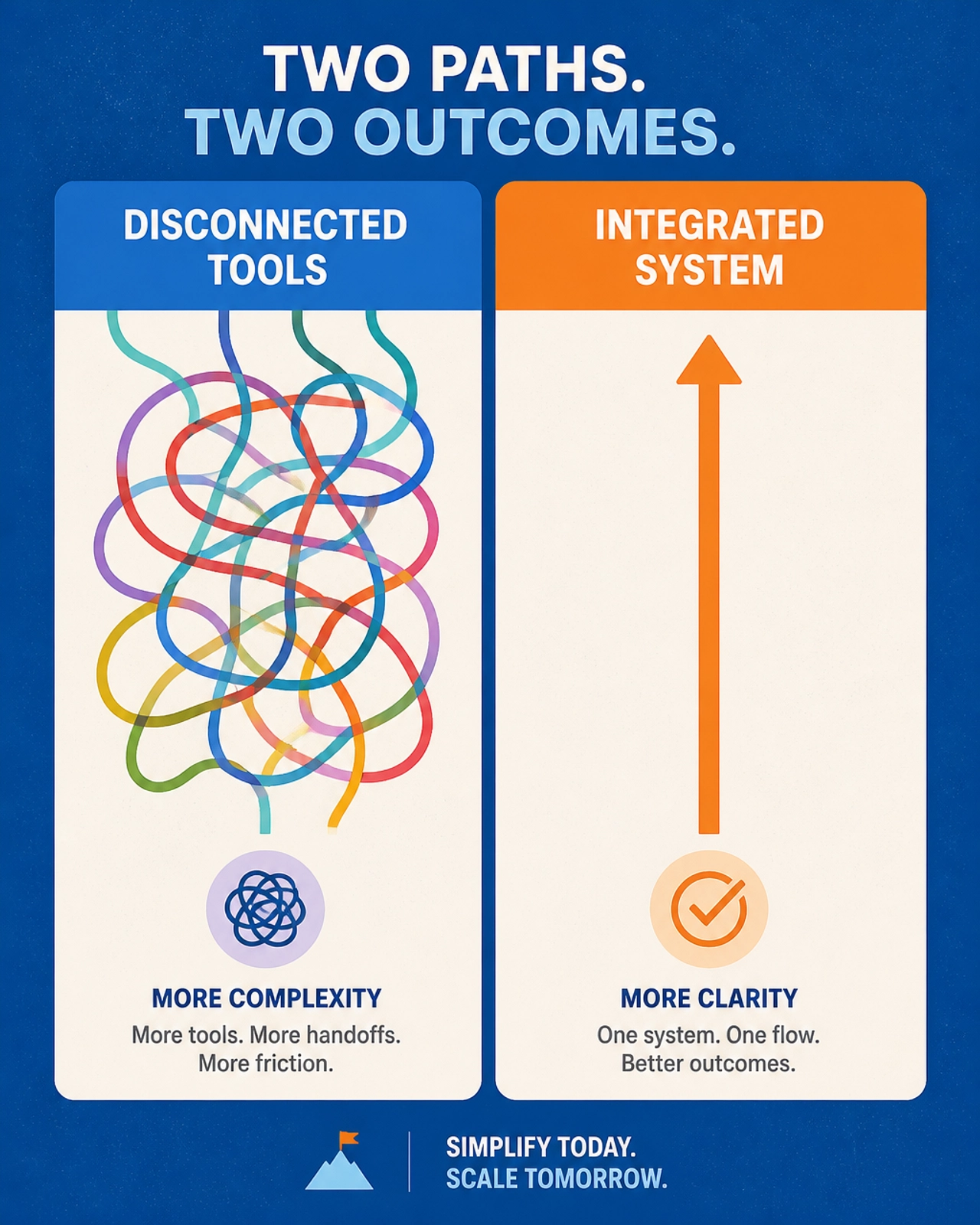
We’ve been conditioned to believe that complexity equals sophistication. In the real world, complexity equals friction. Every new tool you add to your "stack" creates a new point of failure, a new bill to pay, and a new learning curve that steals your most valuable asset: focus.
Let’s look at the "Income Hierarchy" of a failing online business:
- Tier 1: The Tool Obsession. Spending 80% of time on setup and 20% on actual marketing. Results: $0.
- Tier 2: The Shiny Object Loop. Jumping from one "automated" system to another every 30 days. Results: Burnout and a drained bank account.
- Tier 3: The Integrated Execution. Using one simple system to drive traffic and capture leads daily. Results: Consistent growth and predictable ROI.
Most people quit between Tier 1 and Tier 2 because they refuse to face the "messy middle" of hard work. They want a shortcut, so they buy another tool. If that’s you, close this tab now. I’m not here to sell you a dream; I’m here to give you a blueprint for execution.
Reality Check: The Hidden Costs of Your "Free" Setup
You think you’re being smart by stitching together five different free tools. You have a free landing page builder here, a free email service there, and a "hacked" together tracking system.
The Truth: You are paying with your time: the only currency you can’t earn back.
When your data is fragmented across platforms, you can’t see the full picture. You spend hours exporting CSV files and troubleshooting integrations that "broke" overnight. This is low-value labor. It’s a waste of time that should be spent on income-generating activities (IGAs) like creating content and running ads.
If you want to see how most beginners sabotage themselves, read this guide on 7 mistakes you're making with free traffic and how to fix them with DailySwipes. Most of those mistakes stem from trying to be "clever" instead of being effective.
The Execution Blueprint: How to Shatter Overwhelm
To fix the overwhelm, you must adopt a "minimalist marketer" mindset. You need a system where everything talks to each other without you being the middleman.

Here is the 3-step execution plan to simplify your business in the next 24 hours:
1. Audit and Axe
List every subscription and free account you have. If you haven't logged into it in the last 14 days, delete it. If it doesn't directly contribute to capturing a lead or making a sale, cancel it. You don't need a project management suite for a team of one. You don't need a professional video editor for a 30-second social clip.
2. Consolidate Your Hub
You need one central location for your "Link-in-bio," your landing pages, and your traffic sources. This is why we built Daily-Ads. Instead of paying $20/month for a link aggregator and $97/month for a funnel builder, we give you a Linktree Page and a Webpage Builder for free.
3. Focus on the "Vital Few"
There are only three things that matter in the first 90 days of any online business:
- Traffic: People seeing your offer.
- Capture: Getting those people onto a list or a social feed.
- Conversion: Giving them a reason to buy or take action.
Anything else is "recycled garbage" designed to make you feel busy without making you any money. Stop wasting money on overpriced, disconnected networks and try this simple free traffic hack to start seeing real impressions without the technical headache.
The Math of Simplicity (Reverse-Engineering Your Results)
Let's look at the logic. If you use five different tools, your "Complexity Score" is a 10. If you use one integrated platform like Daily-Ads, your score is a 1.
The ROI of 1 vs. 10:
- 10 Tools: 5 hours/week on tech fixes + $150/month in fees + Fragmented Data = Net Loss.
- 1 Integrated Tool: 0 hours/week on tech fixes + $0/month (Free Plan) + 100% Focus on Ads = Profitable Growth.
At Daily-Ads, we have 7,497 members who have generated over 2.9 million banner impressions. These aren't "influencer" numbers; these are real actions taken by real entrepreneurs who stopped worrying about their tech stack and started running their ads.

The Truth About the "Messy Middle"
Results require a 90-day execution window. Most people quit at day 14 because they haven't "gone viral" or made $10k. They blame the tool. They say, "The banner ads didn't work" or "The social feed is quiet."
The Reality: They didn't work. They didn't post every day. They didn't refine their headlines. They didn't engage with the community in the Member Chat.
Legitimate professional services require discipline. If you want to scale, you have to move away from "low-value time wasters" like scrolling through endless tutorials and move toward high-stakes execution.
Stop Spinning Your Wheels
The market doesn't care about your "passion." It cares about demand and delivery. If you are overwhelmed, it’s because you’ve allowed "shiny object syndrome" to dictate your strategy.
You have two choices:
- Continue paying for a dozen tools that don't talk to each other while your bank account remains stagnant.
- Simplify. Consolidate your marketing into one suite. Focus on traffic.
If you are ready to stop playing "business house" and start building a real digital presence, register for your Free Forever account at Daily-Ads today.
No credit card. No "trial periods." Just the tools you need to build, promote, and network in one place.
Commit to a 90-day execution window. Close the extra tabs. Get to work.